
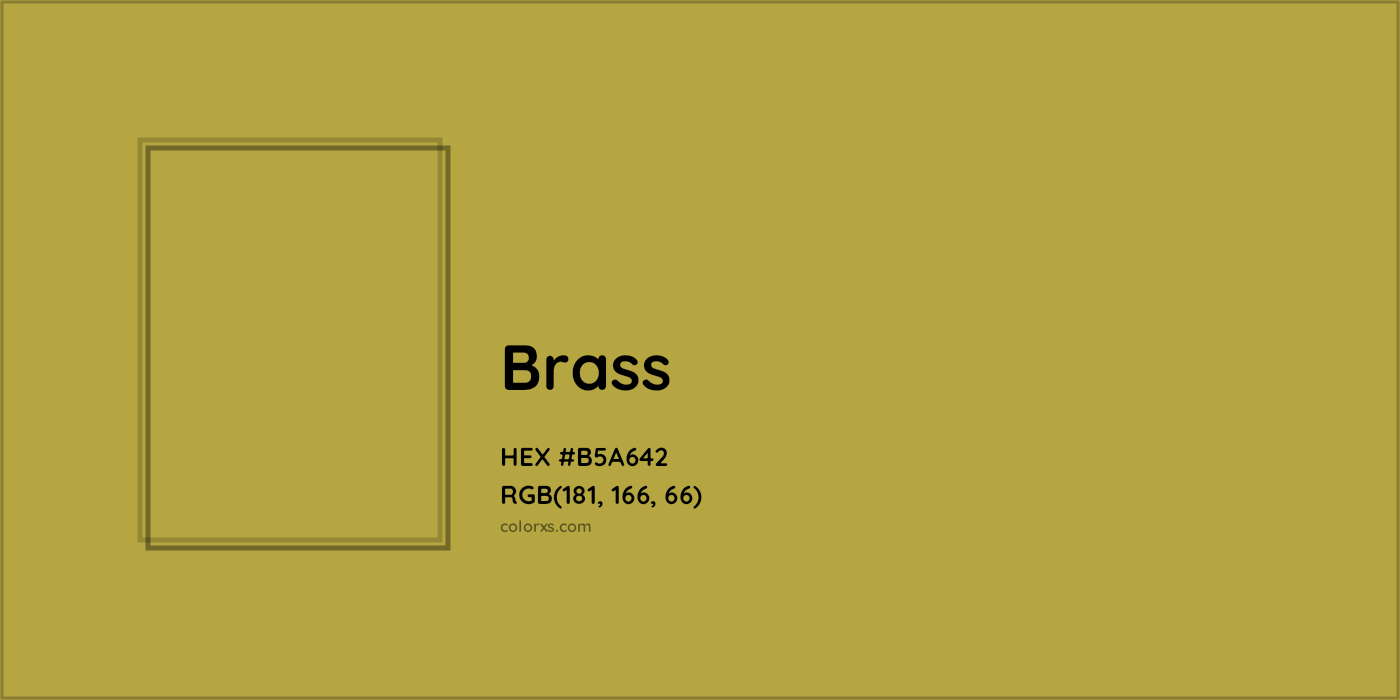
The color Brass represents the color Brass, an alloy of copper and zinc.
What color is Brass?
The hexadecimal color code(color number) for Brass is #B5A642, and the RGB color code is RGB(181, 166, 66).
In the RGB color model, Brass has a red value of 181, a green value of 166, and a blue value of 66. The CMYK color model (also known as process color, used in color printing) comprises 0.0% cyan, 8.3% magenta, 63.5% yellow, and 29.0% key (black). The HSL color scale has a hue of 52.2° (degrees), 46.6 % saturation, and 48.4 % lightness. In the HSB/HSV color space, Brass has a hue of 52.2° (degrees), 63.5 % saturation and 71.0 % brightness/value.
Brass is cool or warm?
The color Brass is a warm color.
What is the LRV of Brass? (For interior and product design)
Brass has an LRV of nearly 37. By LRV value, it is a medium color.
Light Reflectance Value (LRV) is a measure of how much visible light is reflected off a surface. It is a number on a scale of 0 to 100, with 0 being pure black and 100 being pure white. The higher the LRV, the more light the color reflects and the lighter it will appear.
Dark Color
Brass
Light Color
Compare LRV 37 of Brass with dark and light Color
Is Brass Readable? WCAG Contrast Checker (For digital design)
Check if the color Brass meets Web Content Accessibility Guidelines (WCAG) standards, minimum contrast ratio standards between text and background colors. The WCAG (Web Content Accessibility Guidelines) provides global standards for readable web content.
WCAG Recommendations - Large Text: above 18pt or 14pt bold. Normal Text: below 18pt or 14pt bold.
- Minimum contrast ratio (AA): 4.5 for normal text and 3 for large text.
- Enhanced contrast ratio (AAA): 7 for normal text and 4.5 for large text.
Change Background Color:
Normal text - 14pt
Normal Bold text - 12pt
Large text - 18pt
Large Bold text - 14pt
Color Codes - Color Space Conversions
Brass color codes / color number / color space conversions - HEX, RGBA, CMYK, HSL, HSV/HSB, HYZ, CMY, HWB, RYB
RGBA / RGB
CMYK
HSL
HSL(52.17deg, 46.6 %, 48.4 %)
RYB
HSV/HSB
HWB
H: 52.17°
W: 25.88 %
B: 29.02 %
XYZ
X : 33.68
Y : 37.49
Z : 10.62
YXY
Y1 : 37.49
X : 0.41
Y2 : 0.46
CMY
C : 29.02%
M : 34.90%
Y : 74.12%
LRV
Munsell Color System
CIE-Lab
L : 67.64
A : -6.73
B : 52.16
CIE-Lch
L : 67.64
C : 52.59
H : 97.35
CIE-Luv
L : 67.64
U : 14.69
V : 60.72
Hunter-Lab
L : 61.23
A : -8.98
B : 32.58
Similar Colors and Paints
Named colors similar to Brass
Here are the colors similar to Brass . Delta E (ΔE) is the measure of the difference between two colors. Delta E is measured on a scale from 0 to 100, where 0 means exact match, and 100 is the highest difference.
Similar colors from Pantone, RAL, and other color matching system
Pantone TCX
Brass color similar/equivalent colors from Pantone TCX. Conversion of Brass to Pantone TCX
RAL Design
Brass color similar/equivalent colors from RAL Design. Conversion of Brass to RAL Design
Pantone PMS
Brass color similar/equivalent colors from Pantone PMS. Conversion of Brass to Pantone PMS
British Standard 4800
Brass color similar/equivalent colors from British Standard 4800. Conversion of Brass to British Standard 4800
Paint similar to Brass
Here are the best recommended paint colors similar to Brass . Delta E (ΔE) is the measure of the difference between two colors. Delta E is measured on a scale from 0 to 100, where 0 means exact match, and 100 is the highest difference.
Dunn-Edwards
Brass color similar/equivalent paint from Dunn-Edwards. Conversion of Brass to Dunn-Edwards
Valspar
Brass color similar/equivalent paint from Valspar. Conversion of Brass to Valspar
Benjamin Moore
Brass color similar/equivalent paint from Benjamin Moore. Conversion of Brass to Benjamin Moore
Behr
Brass color similar/equivalent paint from Behr. Conversion of Brass to Behr
PPG Paints
Brass color similar/equivalent paint from PPG Paints. Conversion of Brass to PPG Paints
Sherwin Williams
Brass color similar/equivalent paint from Sherwin Williams. Conversion of Brass to Sherwin Williams
Farrow & Ball
Brass color similar/equivalent paint from Farrow & Ball. Conversion of Brass to Farrow & Ball
Color Combinations
View more Brass - #B5A642 color palettes and coordinating colors
Monochromatic colors belong to the same hue angle but different tints and shades. Monochromatic color palette can be generated by keeping the exact hue of the base color and then changing the saturation and lightness.
Analogous colors are a group of colors adjacent to each other on a color wheel. Group of these adjacent colors forms Analogous color scheme Palette. Analogous Palette can be generated by increasing or decreasing the hue value by 30 points.
The triadic color palette has three colors separated by 120° in the RGB color wheel
The tetradic colour scheme composed of two sets of complementary colors in a rectangular shape on the color wheel.
Complementary / Opposite Color
B5A642
Brass
4251B5
Violet Blue*
Complementary / Opposite Color
Complementary colors are pairs of colors which, when combined or mixed, cancel each other out (lose hue) by producing a grayscale color like white or black. When placed next to each other, they create the strongest contrast for those two colors. Complementary colors also called opposite colors. Complementary color schemes are created using two opposite colors on the color wheel. The examples are red–cyan, green–magenta, and blue–yellow.
What is the contrasting color of Brass - #B5A642?
Color that best contrast with Brass - #B5A642 is #4251B5,
color name is Violet Blue*
Contrast indicates a strong difference in color. Contrasting color can be found several ways,
Complimentary contrast is one of them. Complementary contrast colors are opposite each other on the color wheel.
What color compliments Brass - #B5A642?
Complementary or Opposite color for Brass - #B5A642 is #4251B5,
color name is Violet Blue*.
Example Color Images and Mockup
Mobile app mockup example for Brass - #B5A642 color
T-Shirt mockup example for Brass - #B5A642 color
Chart visualization example with Brass - #B5A642 color
Brass - #B5A642 Color Images and Patterns


